Fear of Flying — When Your Body Thinks the Plane Is the Problem (and How to Retrain It)
Fear of flying is rarely about logic.
Most people who struggle with it already know the stats. They know planes are engineered for safety. They know turbulence isn’t the plane “falling.” They know thousands of flights take off every day and land just fine.
And yet—when the cabin door closes, the body reacts like something is wrong.
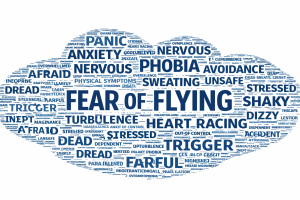
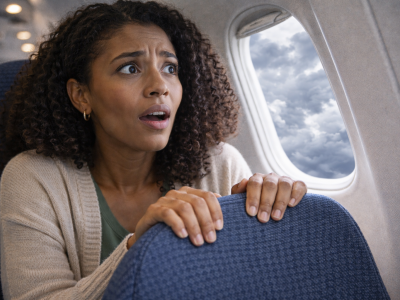
Heart racing. Shallow breathing. Tight chest. Sweaty palms. Nausea. Legs bouncing. A sudden urge to escape. Thoughts that spiral: What if we crash? What if I panic? What if I lose control? What if I can’t get out?
That’s the key point: fear of flying isn’t a knowledge problem. It’s a nervous system problem.
Why fear of flying feels so intense
Flying combines a few triggers that the brain naturally flags as “high stakes”:
- Lack of control (you’re not driving, you can’t “pull over,” you can’t change course)
- Confinement (small space, limited movement, other people close by)
- Uncertainty (sounds, bumps, sensations that feel unfamiliar)
- No easy exit (the most common panic trigger of all)
- Body sensations that resemble anxiety (takeoff pressure, turbulence, ear popping, heart rate increase)
For an anxious brain, those ingredients can create a perfect storm: I’m trapped, I’m not in control, and my body feels weird—therefore something bad is happening.
But here’s what’s really happening most of the time:
Your brain is mislabeling normal flight sensations as danger.
The “two fears” inside fear of flying
Many people believe they’re afraid of the plane crashing. Sometimes that’s true.
But very often, the deeper fear is something else:
- Fear of disaster: “What if something goes wrong?”
- Fear of your own reaction: “What if I panic and can’t stop it?”
That second fear is huge—because it turns anxiety into a threat. And when your brain treats anxiety as dangerous, you get… more anxiety.
This is why some people fear flying even when they’ve flown safely many times. The brain remembers the state (panic, helplessness, dread) more than it remembers the reality.
The “trap” that keeps it going
Most fear-of-flying patterns are maintained by avoidance and safety behaviors:
- Avoiding flights altogether
- Over-checking weather and turbulence forecasts
- Excessive reassurance seeking
- Gripping the armrests, holding your breath, bracing for “impact”
- Constantly scanning every sound and movement
- Overusing distractions that work short-term but teach the brain “this is dangerous”
These strategies can reduce fear in the moment—but they also send a message to your nervous system:
“Good thing we did that… because flying really is unsafe.”
So the fear stays.
What turbulence actually does to the fear response
Turbulence is often the turning point for people, because it feels like loss of stability. The body interprets movement as threat—especially if your nervous system is already on edge.
The problem is not the turbulence itself. It’s the meaning your brain assigns to it:
- “This shouldn’t be happening.”
- “We’re dropping.”
- “This is the start of something worse.”
When you interpret turbulence as danger, your body produces adrenaline. When adrenaline hits, sensations intensify. And then your brain goes: See? I told you something was wrong.
That’s the loop.
How hypnotherapy can help fear of flying
Hypnotherapy can be helpful when you’re mentally “fine” but your body keeps reacting.
A good approach often focuses on:
- Decoupling flight cues from panic response
(so takeoff, turbulence, and cabin sensations stop triggering alarm) - Installing internal control
not control over the plane—control over your state - Reducing anticipatory anxiety
(the days leading up to the flight) - Rewriting the prediction
from “I’m going to panic” to “I know how to settle my system.”
This isn’t about pretending everything is perfect. It’s about teaching your nervous system to interpret the experience accurately—and return to calm faster.
A practical technique for takeoff and turbulence
If you want something you can use immediately, try this. It’s simple, and that’s why it works.
1) Feet + pressure
Press your feet into the floor. Feel the pressure. Let your body register contact and support.
2) Long exhale
Inhale gently. Then exhale longer than you inhale—slow and steady.
(Your exhale is a direct signal to the nervous system: “We can downshift.”)
3) Label the moment
Say in your mind:
“This is sensation, not danger.”
“This is motion, not meaning.”
“This is an alarm, not a prediction.”
That last one matters. The goal isn’t to eliminate all sensation. The goal is to stop your brain from turning sensation into catastrophe.
If the panic thought shows up: “I can’t get out”
This is one of the most common fear-of-flying thoughts, and it’s powerful because it’s partly true: you can’t get out mid-flight.
So don’t argue with it. Reframe it:
- “I don’t need to get out. I need to get through.”
- “I can handle 60 seconds. Then another 60.”
- “This is uncomfortable, not unsafe.”
Panic feels endless, but it comes in waves. If you stop fighting it and start riding it, it often peaks and drops faster.
What a successful flight actually looks like
A lot of people think success means: no anxiety at all.
Not true.
Success can be:
- You feel fear and still board the plane.
- Your heart races and you calm it down.
- You have anxious thoughts and you don’t spiral.
- You experience turbulence and you recover.
- You land and you realize: “I did it.”
Every successful flight trains the brain. Every avoided flight strengthens the fear. That’s not a judgment—just how conditioning works.
And the good news is: conditioning can be reversed.
Work with Ada
If fear of flying has been limiting your life—avoiding trips, dreading upcoming travel, or feeling embarrassed that your body reacts so strongly—I can help you retrain the automatic alarm response so flying becomes manageable and steady again.
And if other people can retrain their nervous system to fly calmly and confidently, you can as well.
Office & Contact Info
Hypnotherapy Advantage
Atrium Medical Arts Building
224 Taylors Mills Rd, Suite 105-a
Manalapan, NJ 07726
ada@hypnotherapyadvantage.com
(732) 333-6680