
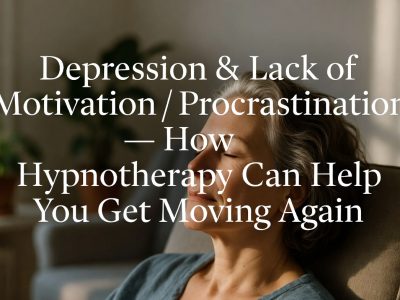
Depression & Lack of Motivation / Procrastination — How Hypnotherapy Can Help You Get Moving Again
Depression isn’t always crying in bed.
Sometimes it looks like functioning… but feeling flat. Going through the motions. Cancelling plans. Starting things and not finishing. Sleeping too much or not sleeping enough. Losing interest in things you used to enjoy. Feeling heavy, foggy, disconnected, or strangely numb.
And when motivation disappears, people often blame themselves:
- “I’m lazy.”
- “I have no discipline.”
- “Other people handle life better than I do.”
But depression and low motivation are rarely character flaws. They’re often a sign that your system has been overwhelmed, depleted, or stuck in a shutdown state for too long.
Motivation is not a personality trait — it’s a state
When your nervous system is regulated, motivation is easier. You have energy, clarity, and a sense of “I can.”
When your nervous system is dysregulated—chronically stressed, emotionally overloaded, or shut down—motivation drops because your brain is prioritizing survival over growth.
That can show up as:
- procrastination that feels impossible to break
- “I want to do it, but I can’t make myself”
- lack of pleasure (nothing feels rewarding)
- low energy and mental fog
- feeling behind, guilty, and stuck
In many cases, the system isn’t refusing to move forward. It’s protecting itself by conserving energy.
The depression loop that keeps you stuck
Depression often forms a loop:
- Low energy / low mood
- Less action (withdrawal, avoidance, reduced activity)
- Less reward (fewer positive experiences and accomplishments)
- More negative thinking (“What’s the point?” “I’m failing.”)
- More shutdown (even less action)
The longer this continues, the harder it feels to break. Not because you’re weak—because the brain learns the pattern.
The “invisible” drivers behind low motivation
Sometimes motivation disappears because of obvious life stress: loss, conflict, burnout, health issues, financial pressure, a major transition.
Other times, the deeper drivers are less obvious:
- Burnout (you’ve been “holding it together” for too long)
- Perfectionism (“If I can’t do it perfectly, why start?”)
- Fear of failure or judgment (avoidance disguised as low motivation)
- Unresolved grief (the body carries it as heaviness)
- Chronic stress (eventually the system shifts from fight/flight into shutdown)
- Low self-worth (“Why bother? I’m not worth the effort.”)
- Learned helplessness (after repeated disappointment, the brain stops trying)
This is why motivation advice like “Just set goals” or “Just push yourself” often doesn’t work. If the nervous system is stuck, pushing can create more pressure—and more shutdown.
How hypnotherapy can help with depression and motivation
Hypnotherapy is not a replacement for medical care, and it’s not about pretending everything is fine. It’s a structured method that can help shift the patterns underneath depression and low motivation—especially the automatic, emotional, and identity-based loops.
Hypnotherapy can support change by working on:
- lifting the emotional heaviness (reducing the “weight” in the body)
- calming the inner critic (the voice that drains energy and fuels hopelessness)
- interrupting rumination (repetitive negative thinking loops)
- rebuilding future orientation (the sense that things can improve)
- increasing internal drive in small, realistic steps
- restoring self-trust (“I can follow through again.”)
For many people, hypnotherapy helps them access a steadier internal state where action becomes possible again—without forcing.
Depression is often a “protective shutdown”
It can help to view depression as a form of protection:
- protection from disappointment
- protection from overwhelm
- protection from emotional pain
- protection from pressure
The system “turns down” feeling and energy so you don’t keep bleeding emotionally. That might have made sense at some point—but now it’s limiting your life.
Hypnotherapy helps the brain and body learn that it’s safe to come back online.
What change usually looks like (realistically)
People often expect change to feel dramatic. More often, it feels like:
- you wake up with slightly more energy
- the “wall” between you and action gets thinner
- you stop overthinking the first step
- you follow through once… then again
- you feel a small spark of interest
- you recover faster after a low day
This is how momentum returns: not in one leap, but in a series of small wins that retrain the brain.
A simple tool for low motivation days
When motivation is low, don’t ask yourself:
“What’s wrong with me?”
Ask:
“What is the smallest next step my body can tolerate?”
Examples:
- take a shower
- walk for 5 minutes
- answer one email
- put one thing away
- eat something simple
- text one person back
Small steps matter because they rebuild evidence:
“I can move. I can do something. I’m not stuck forever.”
The goal: not happiness — aliveness
The goal of hypnotherapy work with depression is not to force happiness. It’s to restore aliveness—energy, connection, meaning, and the ability to engage with life again.
Even when life is imperfect.
Work with Ada
If depression or lack of motivation has been keeping you stuck—and you’re tired of fighting your own mind and body—hypnotherapy can help you shift the deeper patterns that maintain shutdown, self-criticism, and hopelessness, so you can start moving forward again.
Office & Contact Info
Hypnotherapy Advantage
Atrium Medical Arts Building
224 Taylors Mills Rd, Suite 105-a
Manalapan, NJ 07726
ada@hypnotherapyadvantage.com
(732) 333-6680