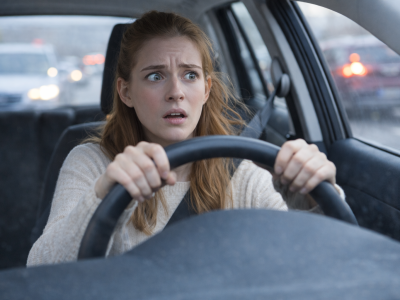
Fear of Driving — When the Road Triggers Your Alarm System (and How to Get Your Confidence Back)
Fear of driving can sneak up on people.
Sometimes it begins after an accident. Sometimes after a close call. Sometimes it starts in a season of high stress, when your nervous system is already running “hot.” And sometimes it appears out of nowhere—one day you’re driving normally, the next day you’re thinking, What if I panic? What if I lose control? What if I can’t pull myself together?
A lot of people feel embarrassed by it. They’ll say:
“I used to drive everywhere. Why is this happening now?”
Here’s the truth: fear of driving isn’t about weakness. It’s usually about your brain learning the wrong lesson from a moment of fear.
The driving anxiety loop
Driving involves speed, decision-making, unpredictability, and responsibility. For an anxious nervous system, that combination can become a trigger.
The pattern often looks like this:
- Trigger (highway, bridge, traffic, left turns, merging, night driving, rain, tunnels, being alone in the car)
- Body alarm (tight chest, dizziness, shaky hands, heat rush, nausea, “floaty” feeling)
- Catastrophic thought (“I’m going to pass out,” “I’ll crash,” “I’ll lose control,” “I won’t be able to escape”)
- Safety behavior (avoid highways, only drive close to home, only drive with someone, grip the wheel, constantly scan, pull over repeatedly)
- Reinforcement (“Good thing I avoided that… it really is dangerous.”)
It’s not that driving became unsafe. It’s that your brain started treating your anxiety as the threat.
What people are really afraid of
Many clients tell me they fear an accident. That can be part of it.
But often, the deeper fear is one of these:
- Fear of panic while driving
- Fear of losing control of your body (dizziness, dissociation, “What if I pass out?”)
- Fear of being trapped (especially on highways, bridges, tunnels, or in heavy traffic)
- Fear of making a mistake (perfectionism, over-responsibility, “What if I mess up?”)
- Fear of other drivers (unpredictability, aggression, tailgating, speeding)
And there’s usually a quiet belief underneath it all:
“If I don’t feel perfectly steady, I’m not safe to drive.”
That belief makes your nervous system hyper-monitor every sensation.
Why highways and bridges are common triggers
Highways and bridges combine two things the anxious brain dislikes:
- Commitment (you can’t stop easily)
- Exposure (you’re in the open, moving fast, surrounded by motion)
For some people, the fear isn’t the road itself—it’s the thought:
“What if I need to escape and I can’t?”
This is why driving anxiety often looks like agoraphobia, even if you don’t fear other places. The car becomes a setting where the nervous system feels “locked in.”
The most misunderstood symptom: dizziness
If driving makes you dizzy, lightheaded, or “off,” that can feel terrifying.
But dizziness is often a byproduct of anxiety physiology:
- shallow breathing
- tension in the neck/shoulders
- visual overload and hyper-focus
- adrenaline changes
Then the mind interprets the sensation as danger, and the loop intensifies.
The goal isn’t to convince yourself you’ll never feel weird again. The goal is to teach your nervous system:
“Even if sensations happen, I remain capable and in control.”
What hypnotherapy can support with driving fear
When fear is learned, it can be unlearned.
Hypnotherapy can help by working with the part of you that reacts automatically—before logic even has a chance.
Sessions often focus on:
- Reducing the alarm response tied to driving cues (highway, merging, traffic, bridges)
- Rewiring the body’s interpretation of sensations (so they stop meaning “danger”)
- Restoring confidence and choice (so you’re driving, not enduring)
- Training mental rehearsal so your system experiences success before you’re on the road
It’s not about forcing yourself through panic. It’s about changing the pattern underneath the panic.
A practical tool for “panic while driving”
If you start feeling anxious behind the wheel, here’s a helpful sequence:
1) Shift your focus outward
Anxiety pulls your attention inside your body. Bring it outside.
Name, silently:
- 3 things you see ahead
- 2 things you see to the side
- 1 thing you see in the distance
Distance vision helps signal safety to the brain.
2) Soften the grip
Notice your hands. Loosen your grip by even 10%.
Tension tells the brain “danger.” Softening tells the brain “control.”
3) Breathe in a way your nervous system understands
Inhale gently. Exhale longer—slow, steady, quiet.
If you can, let your exhale be your anchor.
Then say to yourself:
“This is an alarm. It will pass. I can drive while it passes.”
Because you can.
The step people skip: graded exposure (the right way)
Avoidance keeps the fear alive. But forcing yourself too hard can backfire.
A better plan is small, repeatable wins. For example:
- Sit in the parked car and practice calm breathing (2 minutes)
- Drive around the block (one time per day)
- Drive a familiar route at a calm time
- Practice one “challenge” element (a left turn, a slightly busier road)
- Build up to highways in small segments (one exit at a time)
The nervous system learns through experiences, not arguments. Your brain needs evidence:
“I did it, and I was okay.”
What recovery looks like (realistically)
Driving confidence often returns in stages:
- You stop dreading it as much
- Your body reacts less intensely
- You recover faster when anxiety shows up
- You drive farther without “escape planning”
- You start trusting yourself again
The goal is not perfection. The goal is freedom.
Work with Ada
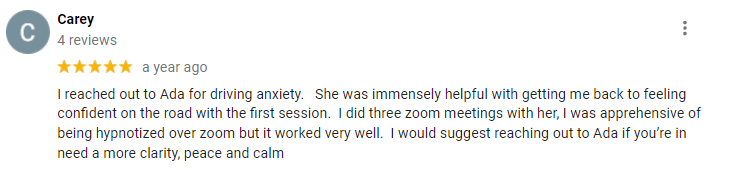
If fear of driving is limiting your life—avoiding highways, relying on others, turning down plans, or feeling trapped by your own symptoms—I can help you retrain the automatic fear response so driving feels steady and manageable again.
Ada — Hypnotherapist
Hypnotherapy Advantage
Visit: HypnotherapyAdvantage.com (use the contact form to reach me)
And if other people can rebuild calm, confident driving one step at a time, you can as well.
Office & Contact Info
Hypnotherapy Advantage
Atrium Medical Arts Building
224 Taylors Mills Rd, Suite 105-a
Manalapan, NJ 07726
ada@hypnotherapyadvantage.com
(732) 333-6680